"When a trooper needs support, they trust that it will arrive. They know this due to the standards and professionalism of The Starfighter Corps. Any mission. Any environment. Any challenge."
― Saga Ke, Kaminoan Scientist
The nature of the pilot program presented a quandary. Clones must operate in units, with mutual support being an absolute necessity.
While this is true of a vast majority of the Grand Army’s units, pilots… represented a significant deviation from that formula.
The conundrum of their training is this: the pilot must be capable of operating in a group with exemplary teamwork, whilst also being perfectly suited to operating independently, and entirely on their own authority.
Thankfully, the nature of their kaminoan training allows for this nearly oxymoronic combination of traits, and even greater success than originally calculated.
When flying in any organized mission, event, operation, or otherwise operating to any capacity, pilots will not perform unnecessary aerobatics or other maneuvers with their airframe that would put either themselves or others at risk.
You are there to perform your duty as a pilot by any means necessary to complete the common objective on behalf of the infantry.
During your initial and routine training sessions, there may be relaxed moments only during periods of overall server downtime or in privatized space for personal practice towards development in controlling your air frame better in specialized scenarios.
Pilots will be verbally warned upon first infraction. Repeated infractions will result in a greater punishment.
You are for all intents and purposes a Pilot - Fly all you want, it's your role.
Ensure you meet 65th Legion's posted takeoff requirements and support the army.
- Do not hover in any airframes under any circumstances.
a. While the LAAT is excluded from this, it is advised you hover minimally to avoid being a target.
b. Obvious exceptions are para-dropping, landing, repairing, scouting, and restocking.
- When fighting an enemy fighter. Don’t focus on an aircraft that someone is already engaging on.
a. You can engage on the same ship if asked to.
- Don’t fly by yourself until you have reached the rank of Corporal, and have earned your Flight Instructor certification.
a. You may fly with another Airman/Wingman as your co-pilot without requiring permission from an officer.
b. Other exceptions are:
- 1. You have permission from any Squadron Leader+ (Master Sergeant and above) within the Starfighter Corps.
- 2. You are asked, requested, and approved by a Senior or Marshal Commander.
- 3. You are asked, requested, and approved by 65th Legion Republic Command.
- 4. You are asked, requested, and approved by a Gamemaster.
- Don’t fly an aircraft that is outside of your rank until you are certified by a trainer.
a. You may fly any aircraft outside of your rank if given permission by an officer+
- Only take out ships that are needed..
a. This also works in regards to the vehicle class. E.G. Don't use the Y-Wing for dogfighting, etc
- Do not do maneuvers that will put the aircraft in danger or cause harm to anyone.
- When dogfighting with other Pilots in trainings, do not blow up their ship.
a. Stop when it starts smoking.
b. Blowing up each other's ships is considered FailRP.
- Your airframe may have limitations according to it's type, such as low atmosphere, high atmosphere, faster speed, etc. Stay where it says.
- Allow 65th Legion & Republic Command to inform you what to do during an event.
a. Aircraft may not always be needed. You can also go fighting on the frontlines.
- During events do not engage on event characters unless directly told to by the Gamemaster or 65th Legion/highest ranking.
a. If you are found doing this you will be getting an instant strike.
b. You may have someone else on your laser but if they hit the event character both troopers will still be taking the punishment
- When leaving your vehicle ensure that it has been locked.
- You must be on radio & on the open pilot frequency when flying. No excuses.
a. The highest ranking pilot should also be passively listening to the Grand Army Frequency to pass over any needed information to pilots.
- PTA's must always be requested when above Sec Level 2
1.1. This also inclueds when there is hostiles in the air or your are repostioning to a readyness postion.
- When requesting a PTA you must inform the reason for PTA and souls on board.
- A pilot should always have a Co-Pilot where possible.
- 65th Legion Pilot may request a PTA in their private commications when the PTA can not be shown publicly.
- Ensure all other Pilot SOPs have been followed.
Priority is given to certain regiments above others. Ensure you are always following the priority, no matter what you are doing, if a trooper with higher priority ask for something to be done you must do it. See the priority list below. (Goes top to bottom)
65th Legion
↓
212th Attack Battalion
↓
327th Star Corps (Medical Issues only)
↓
Base Command
↓
Ground Command
↓
Normal CoC
The Starfighter Corps is the umbrella organization in which covers many fleets, wings, and squadrons across the Galactic Republic's Grand Army & Navy. We are apart of the 7th Fleet Wing, which features three squadrons assigned to our sector.
Within these squadrons, pilots are divided based on balancing needs and certifications. These three squadrons may train on some topics differently, but operate closely in majority to ensure perfect unit synchronization on the field.
The squadrons are as follows;
Mynock Squadron
First in, last out.
Purpose
Long distance patrols
Sensor infiltration and mapping
Personnel and logistical transport specialized
Electronic disruption and comms denial
Covert insertion and high-value extraction
Rapid battlefield logistics under threat
Doctrine
Avoid unnecessary dogfights
Maintain battlefield awareness at all times
Preserve mobility and survivability
Prioritize mission continuity over glory
Culture
Analytical, quiet professionals
Known for endurance missions and long deployments
Pilots cross-trained in navigation, logistics, and radar systems
Calm, adaptable, highly technical
| Nexu Squadron
Control the sky.
Purpose
Fleet, shuttle, and transport defense
High-speed interception
Protection for capital ships
Counter-fighter operations
Offensive counter-air sweeps
Doctrine
Aggressive maneuvering
Close-formation tactics
Shock-and-disrupt engagements
Rapid reaction scramble readiness
Culture
Competitive, intense, and proud
Most decorated squadron in the 5th Fleet
Known for bold maneuvering
Informal motto: “First In the Fight.”
| Acklay Squadron
Deliver the final blow.
Purpose
Heavy strikes and bombardments
Anti-capital ship strikes
Planetary precision sieges
Close orbital support
Hardened target elimination
Long-range strike missions
Doctrine
Coordinated multi-vector attack runs
Ordnance timing discipline
Heavy armor and survivability focus
Works closely with Mynock for targeting
Culture
Methodical and disciplined
Calm under heavy fire
Strong internal cohesion
Known for meticulous mission planning
|
Upon reaching the rank of Pilot/Specialist within the Starfighter Corps, you will automatically be drafted into one of these three squadrons. There are no restrictions towards Squadrons recruiting aspiring pilots at the Airman level as a sort of sponsor.
Starfighter Corps personnel uniquely cannot be promoted or demoted by their regimental superiors. Any rank changes must be coordinated between their regimental officers. With this you will have 2 ranks, one that will be managed by your regimental officers in the background and the main one for the Starfighter Corps.
While apart of The Starfighter Corps, you will notice that there is a layer of ranks beneath the surface of the Grand Army's typical displays. Below you will find details of those pilot-specific ranks, and what they entail.
CADET
Grand Army Starfighter Corps
Recruit
Grand Army of The Republic
REQUIREMENTS
1.) Pass The Starfighter Corps Flight School.
|
You passed the Starfighter Corps Flight School, and have begun your probationary phase, requiring you to be on your best behavior as you work through the next week on a one strike policy.
You must do your best to attend classes, trainings, and build your confidence to test out of the probationary period.
|
AIRMAN
Grand Army Starfighter Corps
Trooper
Grand Army of The Republic
REQUIREMENTS
1.) Pass The Starfighter Corps Flight School.
2.) Survive 1 week as a Pilot Cadet without incident.
3.) Pass a basic Pilot Course.
|
You've successfully made it a week without causing an issue. After completing a basic course of Pilot training, you become eligible to move up to the first official pilot rank of Airman, and truly begin your career.
You must do your best to attend classes, trainings, and build your confidence to test out of the probationary period.
|
WINGMAN
Grand Army Starfighter Corps
TROOPER
Grand Army of The Republic
REQUIREMENTS
1.) Pass The Starfighter Corps Flight School.
2.) Complete all required Airman modules.
|
You've begun to earn your wings through the trials of the probationary period. You should be more confident in your ability to run transport or strike operations with a squadron or crew as you complete final educational modules.
RESPONSIBILITIES
1.) Attend at least 5 debriefs of operations you were apart of every week.
2.) Attend at least 1 training every week, or conduct personal training once per week.
3.) Communicate with leadership if unable to attend functions
4.) Official accommodation can be provided on an as needed basis
5.) Learn the contents of this handbook from top to bottom.
6.) Increase familiarity with all available airframes before moving to ground vehicles.
7.) Have confidence in possessing the AUTHORITY over your airframe.
|
PILOT
Grand Army Starfighter Corps
SPECIALIST
Grand Army of The Republic
REQUIREMENTS
1.) Pass The Starfighter Corps Flight School.
2.) Complete all required Wingman modules.
|
DESCRIPTION
You are a full fledged pilot, capable of handling your airframe with ease in the most stressful situations and have passed every test the Starfighter Corps has given you thus far.
RESPONSIBILITIES
1.) Attend at least 5 debriefs of operations you were apart of every week.
2.) Attend at least 1 training every week, or conduct personal training once per week.
3.) Communicate with leadership if unable to attend functions
4.) Official accommodation can be provided on an as needed basis
5.) Learn the contents of this handbook from top to bottom.
6.) Increase familiarity with all available airframes before moving to ground vehicles.
7.) Have confidence in possessing the AUTHORITY over your airframe.
|
FLIGHT INSTRUCTOR
Grand Army Starfighter Corps
CORPORAL
Grand Army of The Republic
REQUIREMENTS
1.) Pass The Starfighter Corps Instructor School.
2.) Complete all required Pilot modules.
3.) Obtain the rank of Corporal.
|
DESCRIPTION
Upon reaching Corporal, you are eligible for the title and role of Flight Instructor due to your dedication and growth within the Starfighter Corps. It would be wise to bestow this hard earned knowledge to the next generation in the next step of the Instructor Program.
RESPONSIBILITIES
1.) Attend at least 5 debriefs of operations you were apart of every week.
2.) Attend at least 1 training every week, or conduct personal training once per week.
3.) Host at least 1 trainings every two weeks.
4.) Communicate with leadership if unable to attend functions
5.) Official accommodation can be provided on an as needed basis
6.) Memorize the contents of this handbook from top to bottom.
7.) Increase familiarity with all available airframes and ground vehicles.
8.) Have confidence in possessing the AUTHORITY over your vessel.
|
SQUADRON LEADER
Grand Army Starfighter Corps
MASTER SERGEANT
Grand Army of The Republic
REQUIREMENTS
1.) Pass The Starfighter Corps Officer School.
2.) Complete all required Pilot modules.
3.) Obtain the rank of Master Sergeant.
|
DESCRIPTION
Upon reaching Master Sergeant, you are eligible for the title and role of Squadron Leader due to your dedication and growth within the Starfighter Corps. It would be wise to bestow this hard earned knowledge to the next generation in the next step of the Instructor Program.
RESPONSIBILITIES
1.) Attend at least 5 debriefs of operations you were apart of every week.
2.) Attend at least 1 training every week, or conduct personal training once per week.
3.) Host at least 1 training every week.
4.) Communicate with leadership if unable to attend functions
5.) Official accommodation can be provided on an as needed basis
6.) Memorize the contents of this handbook from top to bottom.
7.) Increase familiarity with all available airframes and ground vehicles.
8.) Have confidence in possessing the AUTHORITY over your vessel.
|
¶ Standard Operating Procedures
The following loadout is required for takeoff and operation of any vehicle. Ensure that you are equipped with the following loadout prior to boarding.
a.) AVI-Class Armor. (or any pressurized oxygen-rebreather equipped armor.)
b.) DC-15A. or DC-15S (Any rifle or carbine will suffice.)
c.) DC-17. (Any sidearm will suffice.)
d.) Flare Gun.
e.) Infantry Resupply Kits.
The following can be added/resupplied to your loadout at your own discretion.
a.) Extra Flare Rounds (Any quantity, 6+ recommended.)
b.) Colored Smoke Grenades. (Any quantity.)
c.) Smoke Grenades. (Any quantity.)
The following loadout additions are prohibited from your loadout when piloting aviation assets.
a.) Blaster Repeaters, Cannons, Long Rifles, or any massive weapon that may disrupt pilot operation or cargo space.
b.) Any unauthorized explosive or flammable weaponry, cargo, or other assets without proper certifications or personnel such as Grenadiers.
Any Pilot not actively running transport may take up an Air Superiority fighter capable of air-to-air combat such as the ARC-170, Z-95, or the V-Wing to perform escorts for transports and other vehicles.
The Z-95 and V-Wing are best-served when used to escort aircraft and provide security when they are the most vulnerable, especially during landings, rescues, or resupply missions.
¶ Crash Landing & Mayday
- Use the least amount of drastic manuevers necessary, up to and including violent feedback force, in order to protect your airframe.
- Use any means required to safely extract yourself and any survivors when shot down.
- Regrouping with the nearest Republic party or returning to base with everyone in tact should be your mission after mayday.
- CAS runs are highly effective at taking out a group of hostile, buildings, and structures. While being highly effective they are also extremely dangerous and require tight regulations.
- If you are to do a CAS run ensure you have read through the regulations carefully here.
Pilot's and other troopers have access to coloured smoke within their arsenal. These should only be used as a visual identification for Pilots. The smoke should not be used for tactical reasons.
There are 4 different smoke colours, each colour should be used for the following reasons:
- Red - Hostile/Enemy location
- Blue - VIP, HVT, HVTE or Asset Recovery
- Green - Mark friendly location (Can also be used to mark EVAC position)
- Yellow - CASEVAC/MEDEVAC location
The transportation of infantry is a Pilot's primary role during any operation. It is the job of all pilots to ensure that this job gets completed safely and efficiently. Airframes such as the LAAT/i or the Rho-class excel at transporting infantry.
Inserts happen at the beginning of any mission or operation. It is the job of the acting primary Commander or command member to coordinate with you on when, where, and how they are getting to the objective.
A reinsert is when a pilot transports respawning troopers back to their units in the field. This should be a constant responsibility with occasional clearance from 65th.
A Drop Zone allows 212th Attack Battalion Paratroopers or Advanced Recon Troopers to airdrop into the objective using their jetpacks.
Some scenarios require a callback of some units to return from the field for intelligence, garrison balancing, or medical reasons. See MEDEVAC/CASEVAC below.
A High Value Target Extracts (HVTE) will exclusively be called in and coordinated over a secure Pilot communications frequency. These situations must be handled with extreme caution and focus.
Final extractions are called Endex Extraction, or endex for short, where you are to return everyone to the current base at the end of any given operation. Final call.
Your crew may dismount at any time to assist in protecting the extraction point, although it is the infantry's responsibility.
MEDEVAC - The evacuation/extraction of injured clone troopers.
CASEVAC - Evacuation of clone troopers who are being directly engaged by the enemy and are in need of emergency extract.
Pilots will often be called in over Pilot Open Comms voice or in (Republic Communications) text for CAS missions in order to take out ground targets. Grid markers are required, and the order must be coming from the highest ranking ground unit, their designated communicator, or a 41st Elite Corps Tactician.
Reconnaissance of an objective is an essential tool for infantry to be better prepared before entering an objective. Pilots may assist the 41st Elite Corps in providing preliminary flyover communication, or by airlifting them to a vantage point. You may also give them a high altitude vantage point with your airframe assuming you may open the doors with stability.
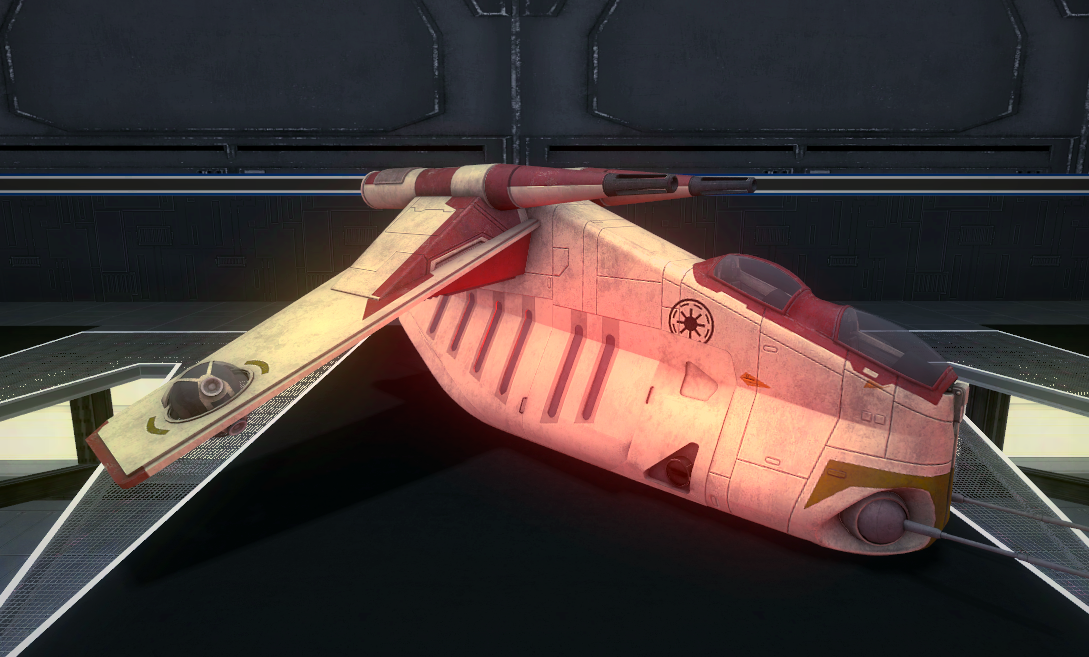
LAAT/i Gunship ILAAT/i Gunship II
|
Classification
Transport / Gunship
Specifications
Top speed is 230 - 250 units/second
Total mass of 75,000
55% performance rating
Carries 4 crew members & 16 passengers
Carries 1 BARC Speeder or AT-RT Walker
Armaments
Light Cannons
Zephyr Torpedoes
Rank Requierments
Recruit
|
|
|
Classification
Transport / Gunship
Specifications
Top speed is 380 - 430 units/second
Total mass of 62,000
65% performance rating
Carries 4 crew members & 16 passengers
Carries 1 BARC Speeder or AT-RT Walker
Armaments
Light Cannons
Heavy Autocannons
Zephyr Torpedoes
Rank Requierments
Specialist
|
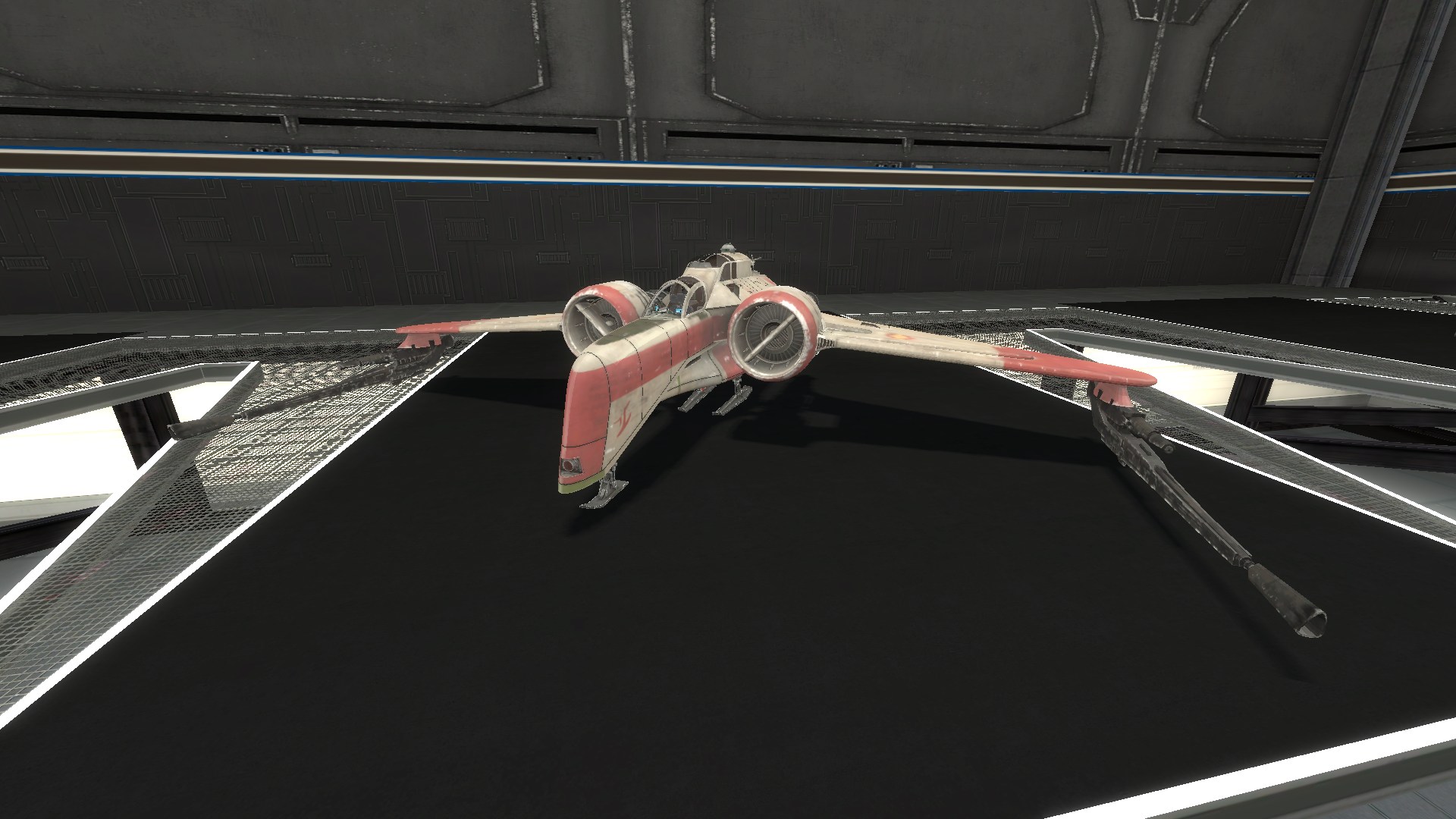
The Advanced Reconnaissance 170 (ARC-170) is a multi-role fixed wing airframe. The ARC-170 can conduct a vast amount of tasking to support successful missions
With the ARC-170 vercitail airframe it is able to engauge with targerts both in the air and on the ground. The ARC-170 is able to perform Basic Fighter Maneuvers (BFM) to engauge with hostlies. The weapons on board allow the ARC-170 to perform a foucsed CAS run.
ARC-170 Gen IARC-170 Gen IIARC-170 Gen III
|
Classification
Fighter
Specifications
Top speed is 170 - 300 units/second
Total mass of 15,000
65% performance rating
Carries 3 crew members
1 Pilot, 1 Co-Pilot, 1 Rear Gunner
Armaments
Light Cannons
Zephyr Torpedoes
Rank Requierments
Clone Trooper
|
|
|
Classification
Fighter
Specifications
Top speed is 170 - 300 units/second
Total mass of 17,000
65% performance rating
Carries 3 crew members
1 Pilot, 1 Co-Pilot, 1 Rear Gunner
Armaments
Light Cannons
Voltic Cannon
Zephyr Torpedoes
Rank Requierments
Lance Corpral
|
|
|
Classification
Fighter
Specifications
Top speed is 200 - 340 units/second
Total mass of 19,000
70% performance rating
Carries 3 crew members
1 Pilot, 1 Co-Pilot, 1 Rear Gunner
Armaments
Light Cannons
Voltic Cannon
Zephyr Torpedoes
Wraith Small Diameter Bomb
Rank Requierments
Heavy Pilot & Master Sergeant
|
Pilots are able to fly needed equipment and vehicles into landing zones to assist ground troops.
Asset recovery is the act of logistically transporting downed or destroyed assets from the field back to the active base.
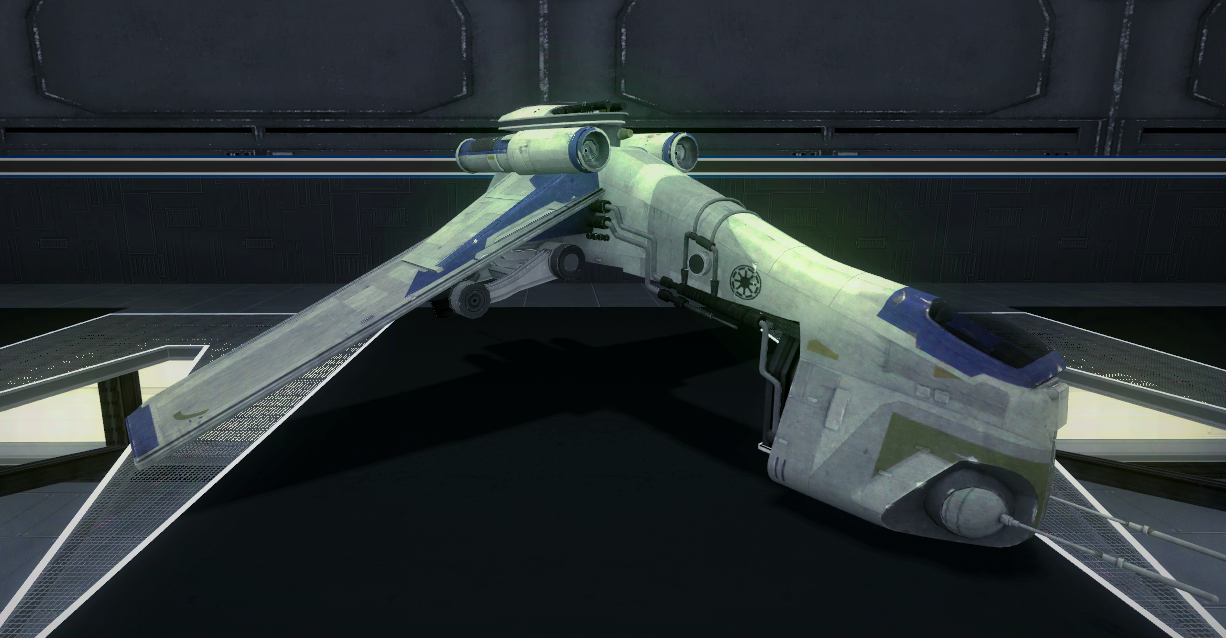
Wreckage recovery using the LAAT/c involves waiting for the area to be relatively safe then going out into the field, picking up the wreck and transporting it back to base and filling out a report.
Pilots will be tasked with vehicle transport using the magnetic clamps on our LAAT/c airframes.
AT-RT (Walker)
BARC (Speeder)
ATC-X (APC)
TX-210 (APC)
TX-130 (Tank)
IFT-X (Tank)
TX-427 (Tank)
AT-TE (Walker)
HAVw A6 (Tank)
|
Classification
Heavy Transport / Dropship
Specifications
Top speed is 190 - 230 units/second
Total mass of 85,000
45% performance rating
Carries 2 crew members
Armaments
Light Cannons
Rank Requierments
Specialist
|
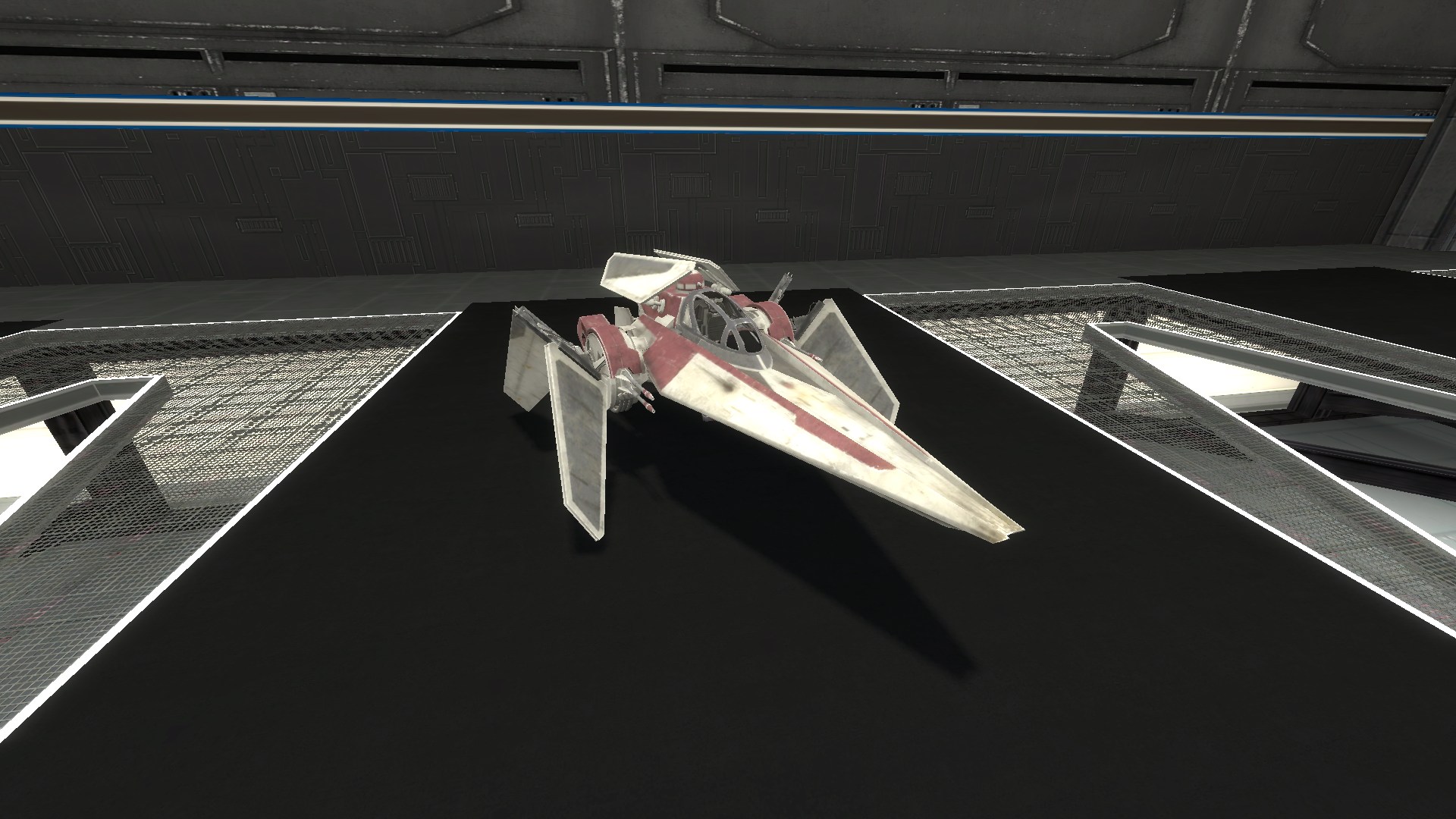
With the V-Wing's light airframe it allows it to excell in any enviroment, from tight turns to sailing through a cave it's one of the most agile aircraft in the republic's aresnal. The V-Wings on board aresnal allows it to stay up in the air for long period of times and deal with multiple hostile aircraft at once.
|
Classification
Air Superiority
Specifications
Top speed is 220 - 320 units/second
Total mass of 20,000
70% performance rating
Carries only 1 Pilot
Armaments
Light Cannons
Heavy Shoutgun
Zephyr Torpedo
Rank Requierments
Master Sergeant
|
The Z-95's airframe isn't made for tight turns, intense dog fights or fight muliple ariel hostiles at once. The Z-95 is mainly used for Air to Ground support and in a convey to protect other aircraft but can offer help in small Air to Air combat.
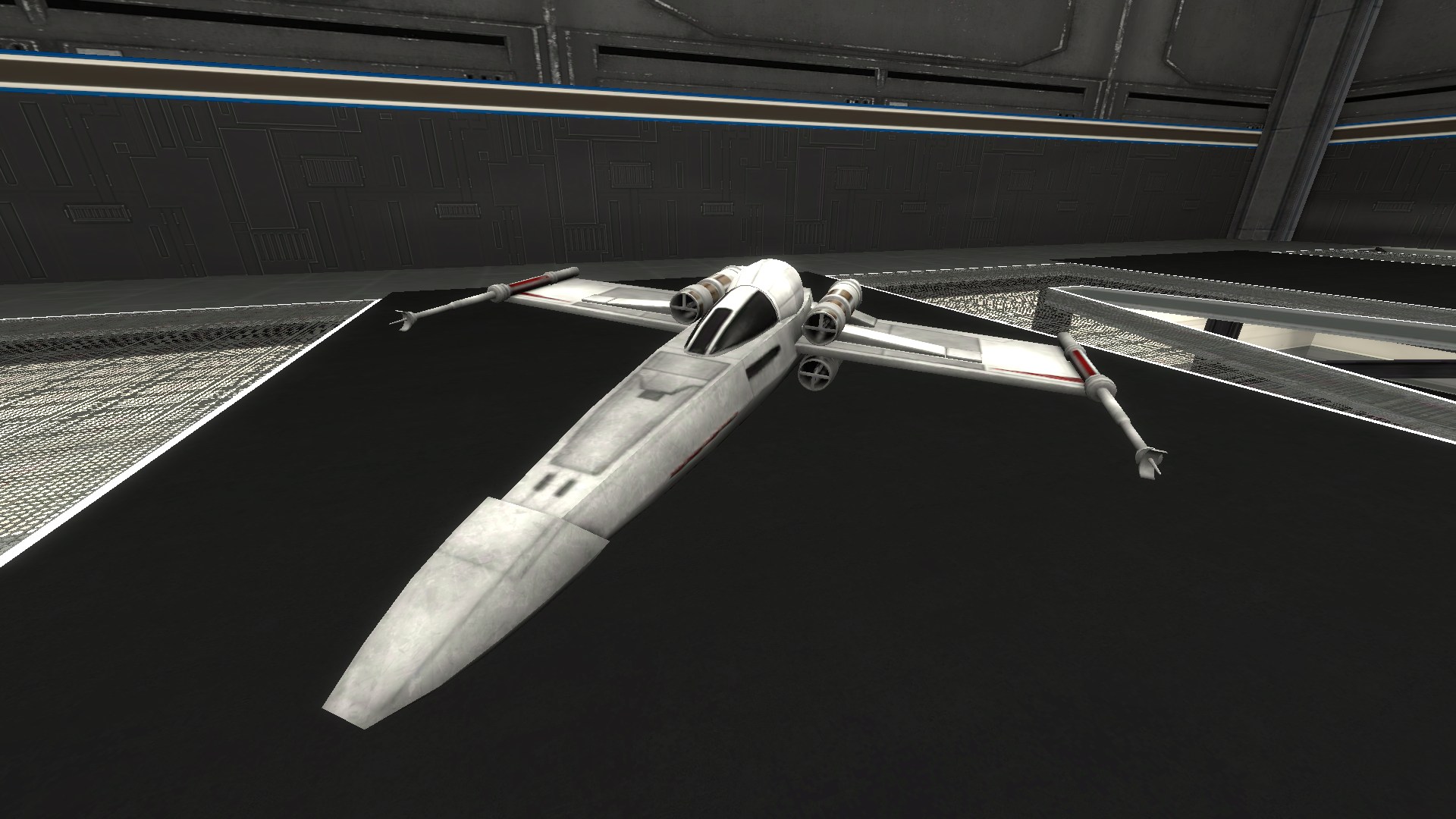
|
Classification
Air to Small Ground Support
Specifications
Top speed is 190 - 330 units/second
Total mass of 10,000
75% performance rating
Carries only 1 Pilot
Armaments
Light Cannons
Heavy Repeater
Zephyr Torpedo
Rank Requierments
Sergeant
|
The T-51 Strikefighter airframe isn't made for tight turns, intense dog fights or fight muliple ariel hostiles at once. Where the T-51 Strikefighter is powerfull is with it's great handleing at low speeds to target ground hostiles
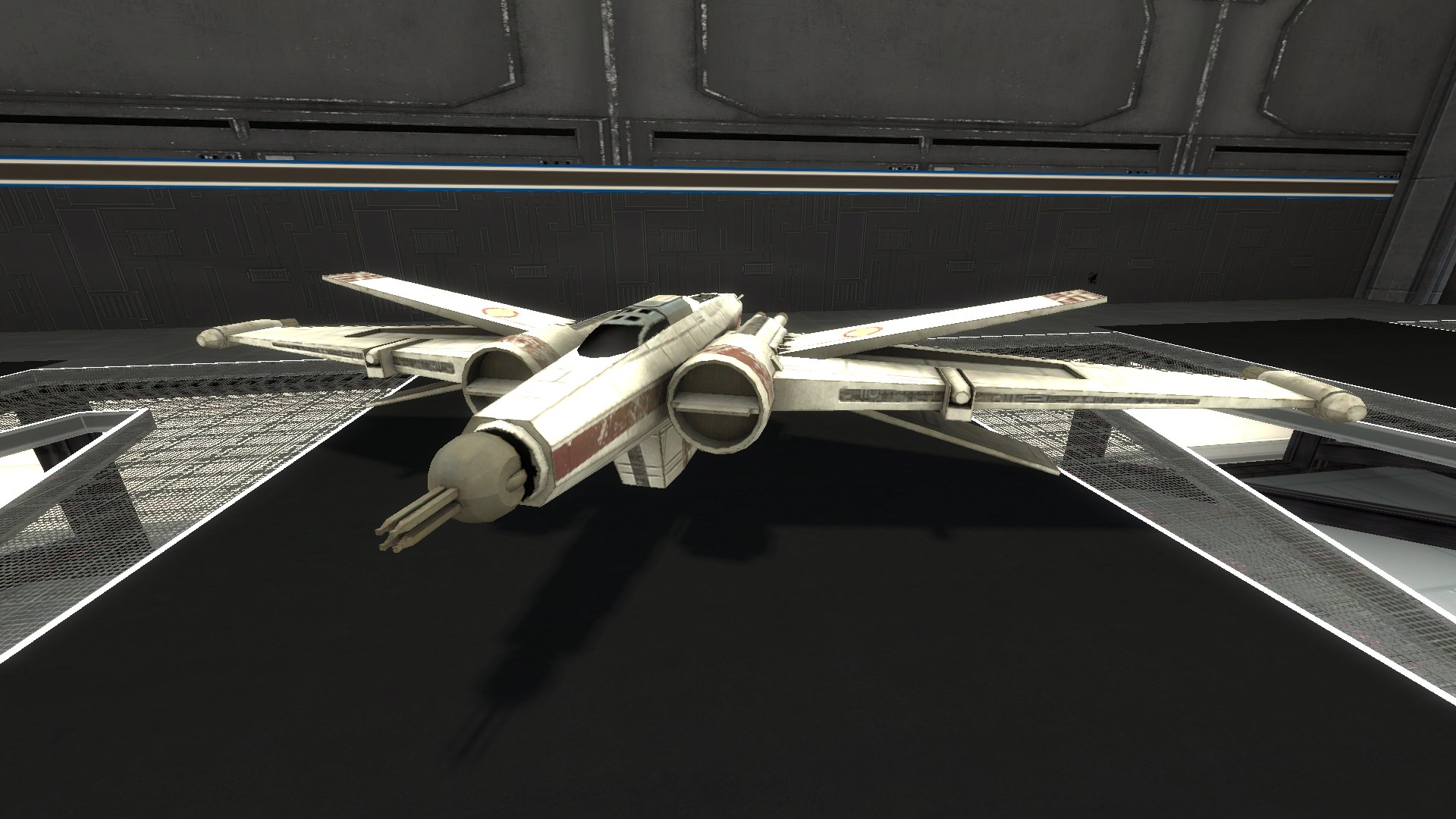
|
Classification
Air to Ground Support
Specifications
Top speed is 170 - 270 units/second
Total mass of 25,000
55% performance rating
Carries only 1 Pilot
Armaments
Heavy Repeater
Zephyr Torpedo
Wraith Small Diameter Bomb
Rank Requierments
Heavy Pilot & Sergeant
|
The T-51 Strikefighter airframe isn't made for tight turns, intense dog fights or fight muliple ariel hostiles at once. Where the T-51 Strikefighter is powerfull is with it's great handleing at low speeds to target ground hostiles
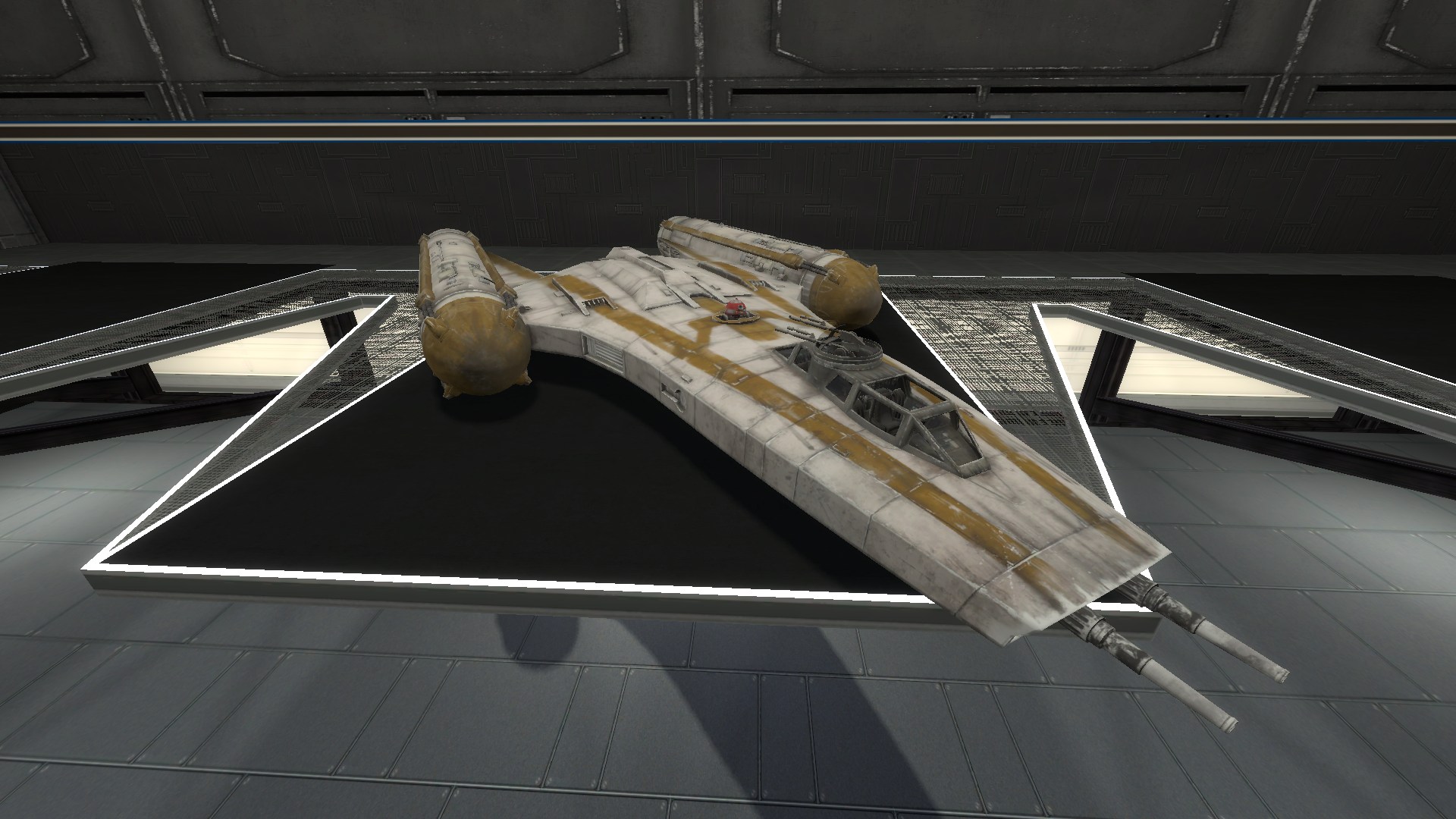
|
Classification
Air to Ground Support
Specifications
Top speed is 140 - 230 units/second
Total mass of 80,000
40% performance rating
Carries 1 Pilot & 1 Gunner
Armaments
Heavy Repeater
Hurricane Rockets
Wraith Small Diameter Bomb
Rank Requierments
Heavy Pilot & Sergeant
|
Assets available to Pilots have a large variety of weapons that can be employed for various different tactics, fulfilling Air-to-Air engagements, Air-to-Ground tasks, and Ground related conflicts.
Almost all vehicle frames come equipped with Pilot operated cannons as standard. Depending on the vehicle frame these may vary in purpose, damage potential and specialization.
Heavy Repeaters are weapons designed to allow for less powerful impacts designed for use in immediate vicinity of friendly infantry or extremely close air support.
Useful for super tight proximity CAS or engaging targets in difficult situations nearby friendlies, this weapon provides the pilot with a reasonable defense without endangering other clones.
Light standard cannons serve as a typical primary weapon on most vehicles, specifically airframes, and are the best use close range Anti-Air weapon as they travel faster and can efficiently hit other air targets. They provide only impact damage and do not have an explosive effect. This makes them poorly suited to CAS taskings.
These standard cannons fire at an average rate of 800 RPM, although they do vary between vehicles. Most airframes and vehicles have a default 1200 round belt. As of December 2025, all vehicle primary cannons do not run out of ammunition; they only overheat.
The Voltic cannon is a weapon equipped only on the ARC-170B & ARC-170C. Carrying a 32-round magazine, each round deals 500 damage per direct hit making it excel at precision strikes.
Coaxium also has a large splash radius of around 65 units dealing an additional 150 splash damage and a rate of fire of 5800 RPM.
Voltic rounds also have minimal dispersion, meaning they are highly accurate at range. This makes Voltic an excellent choice for CAS on any target.
The Autocannon is a powerful weapon found only onboard the LAAT/i airframe that is well suited to providing Close Air Support with extremely powerful rounds over a specific area. The Autocannon fires at a rate of 150 RPM with roughly 30-60 rounds loaded per LAAT and deals major impact damage on a direct hit.
The surrounding area of effect deals extra damage over a radius of around 50 meters. With minimal dispersion over range and being capable of engaging both soft and hard targets, this weapon makes for an excellent all-rounder provided friendlies are sufficiently far away.
The Zephyr is a short-range lock-on capable missile. This missile can be carried by most airframes and can be used to engage airborne targets effectively from a good distance out.
A single Zephyr is enough to destroy most airborne targets but due to its limited range should be utilized at closer ranges.
Zephyr projectiles may expire after some time in flight.
The Hurricane Rockets are unguided 2.75” rockets that can be mounted to the pylons of most aircraft.
Hurricanes can be fired in single or with automatic fire allowing for different levels of saturation on the target
Each Rocket has a direct impact damage of 500 with a splash damage range of 120 units dealing 250 damage
Hurricanes are well suited to area denial as their limited aiming ability restricts their use for Precision CAS.
The Wraith is a laser guided 500lb bomb which is targeted through use of a laser sensor and laser designator via another aircraft or an RTO. These are carried by the ARC-170C, Striker-class LAAT/i, and the Y-Wing and are suitable for high altitude precision strikes. The use of a Wraith requires good communication from the designator and pilot.
The Wraith Deals 1000 direct impact damage with a splash damage of 500 over 80u.
Slagger
The ball gun fires over 3000 rounds per minute and is capable of killing ANYTHING within seconds. Efficient use of the ball turret requires controlled bursts instead of continuous fire.
To bind something in console, replace key with any key on your keyboard.
Make sure to replace [Callsign] with your assigned callsign surrounded with brackets.
For a list of source engine keybinds, see their wiki.
https://developer.valvesoftware.com/wiki/Bind
PERMISSION TO TAKEOFF
|
bind key "say /pcomms [Callsign] to command, requesting permission to takeoff.
|
LANDING (RUNWAY)
|
bind key "say /pcomms [Callsign] is coming in for landing - clear the runway.
|
LANDING (AREA)
|
bind key "say /pcomms [Callsign] is landing - keep the area clear.
|
LANDED (EVAC)
|
bind key "say /pcomms [Callsign] has landed - doors are open.
|
LANDED (ENDEX)
|
bind key "say /pcomms [Callsign] has landed, engines shutting down.
|
TAKING FIRE
|
bind key "say /pcomms [Callsign] is taking fire - performing evasive maneuvers!
|
ENGAGING TARGETS
|
bind key "say /pcomms [Callsign] is being engaged by enemy targets, returning fire!
|
REQUESTING REINFORCEMENTS (AIR)
|
bind key "say /pcomms [Callsign] has confirmed enemy targets in the sector - requesting any available air assets to assist.
|
REQUESTING REINFORCEMENTS (GROUND)
|
bind key "say /pcomms [Callsign] has confirmed enemy targets in the sector - requesting any available ground assets to assist.
|
- LAAT Certification
- Try-Out Requirements
- Training Suggestions
- CO - Commanding Officer
- FC - Flight Commander
- SL - Sector Leader
- FAC - Forward Air Controller
- CTAF - Common traffic advisory
- Tower - traffic control
- CAS - Close Air Support
- CAP - Combat Air Patrol
- SEAD/DEAD - Suppression/Destruction of Enemy Air Defenses
- Weasel - The act of drawing fire and evading said fire, with the purpose of preventing more valuable friendlies to be engaged, and waste - enemy ammunition
- Defensive - A pattern of flying actions that disallows firing upon the enemy in order to survive fire
- ASL/AGL - Above Sea Level / Above Ground Level
- SR - Short range (radio - e.g. AN/PRC-152)
- LR - Long Range (radio - Intercommunicator Pack, AN/PRC-117F)
- Freq - Frequency
- Tac - a “.” - “501.1” would read “five-oh-one-TAC-one”
- Certification - a training and test to qualify a pilot to operate a certain airframe
- Mastery - A test to indicate a pilots skill
- Ground noise - Due to the manner in which Radio waves propagate, Radar indications become confused when close to the ground. Called “Noise” to indicate the - improbability of a clear sensor picture, and thus, sensor systems ability to clearly identify signatures.
- Active Radar - A radar transmitter-receiver (meaning it sends out waves, and can “hear” or “see” the reflections. Also called a “transceiver”) When the - Radar is toggled “ON” it will actively return targets with a signature that are in range, and clearly visible.
- Passive Radar - A Radar receiver (only) that can “see/hear” the radar emissions of targets, such as other aircraft, or some missiles.
- IR - Infra-red. Heat is infra-red radiation escaping an object.
- Visual - The optical sensor such as the LAAT/i’s “Targeting Camera”, or the “Eyeball, Mk 1”
- Datalink - The ability for aircraft/missiles to send and/or receive sensor returns to other friendly aircraft/missiles
- BP - Battle Point - a safe area in which Rotary aircraft stage and await tasking/perform reconnaissance
- IP - Ingress Point - an area in which Fixed-wing Aircraft remain (typically an orbit) and perform recon/await tasking
- EP - Egress point - a designated area in which aircraft will exit an operational area to control traffic flow in combat
- AP - Attack Point - A line or area in which aircraft engage targets freely in order to deny/control movement through an area
- Cleared Hot - a phrase meaning that the pilot has been given permission to engage a certain target or all targets within an area
- Furball - a colloquial term describing the confusing shape of a massed dogfight
- Interception - To move close to a target before it reaches its intended point and deny it further progression
- Interdiction - to destroy a target before it reaches its intended point
- BVR - Beyond Visual Range - Sensors can see it, but your eye cannot
- HUD - Heads up display - the floating lines in a cockpit that display information
- Recon - Reconnaissance - the process of searching and surveying an area for valuable information, to include but not limited to: Enemy location, friendly - location, key terrain, cover/concealment etc.
- TiG - Time in Grade - The time that has passed since promotion to a certain rank
- TiS - Time in Service - the amount of time since joining the Starfighter Corps
- Fighter - an aircraft designed to maneuver and bring effective fire upon enemies at close range
- Bomber - an aircraft that is designed to deliver payloads (typically bombs) against static targets or areas from high altitudes or long distances
- Striker - an aircraft designed to destroy specific targets to minimize collateral damage and maximize probability of target destruction
- Interceptor - An aircraft capable of interception and interdiction.
- Multirole - an aircraft designed to fill multiple roles in combat, e.g. CAS/Fighter
- SERE - Survival, Evasion, Resistance, Escape
- LZ - Landing Zone
- DZ - Drop Zone
- Sunset - all air assets are no longer in the Area of Operations
- Break - When used in combat, it means to perform a maximum-rate turn in an indicated direction to avoid collision/fire
- Rotary - Aircraft that operate on a helicopter flight model
- Fixed Wing - aircraft that operate on a jet flight model
- VTOL - Aircraft that are capable of Vertical Take-Off and Landing
- Missile - Guided munition driven by a rocket motor
- Rocket - Unguided munition driven by a rocket motor
- Orbit - A pattern of flight that is circular
- Dogfight - Close-in engagement of aircraft with guns and short-ranged missiles
- AO - Area of Operations
- FLOT - Forward Line of Own Troops (Frontline)
- AA - Anti-Air
- AAA - Anti-Air Artillery
- FEBA - Forward Edge of Battle Area
|
